
At the commencement of hostilities, John Fonda had some difficulty with Alexander White, sheriff of Tryon county, about their hogs and cattle breaking in upon each others premises, which resulted in a quarrel, in which White called Fonda "a damned rebel"; and the latter, provoked to anger, did not scruple to give his majesty's peace officer a severe caning: the result was, White took Fonda to the Johnstown Jail. The Citizens in a mob soon after proceeded to the jail and liberated Fonda, and attempted to secure the person of the sheriff, then at the village inn kept by Mattice.
Armed with a double-barreled gun, White fired several times on the assailants from an upper window, and then secreted himself in a chimney, where he remained while the patriot party, who had forced an entrance, were in the house. Soon after, sheriff White, whose official authority was now at an end, was smuggled from Johnstown in a large chest by his political friends; and his wife shortly after followed his fortunes to Canada. The dwelling, vacated by White, was occupied by John Fonda afterwards. The property, owned at his death by Sir Wm. Johnson, stood on the present site of the Montgomery County Courthouse in Fonda.
Two sons of Adam were twins, Douw Henry and Henry Douw; prior to Henry Douw's death in 1891 at age 81, they had the distinction of being the oldest male twins in the country. Douw Henry Fonda (1809-95) owned 233 acres; he married Ann Veeder, (1810-90) daughter of Albert Veeder, son of Col. Abraham Veeder. Soon after their marriage, they took up residence in the small stone house then standing on the farm willed to him by his father, becoming the third successive owner since his patentee great grandfather, Douw "The Patriot" Fonda, to whom it had been granted in 1748. His family grew rapidly, the stone house became the foundation of the second home, a frame structure which Douw and Ann began to replace by a still larger one in 1848, completed in 1856.
On September 13, 1833, Douw Henry Fonda was appointed a Sergeant, under the command of Daniel Moore, in the 34th Regiment, 11th Brigade, 14th Division of the New York State Militia. As such he served seven years. He was exempted from military duty on November 10, 1840; his certification was signed by his older brother, Brigadier-General Peter Henry Fonda (1802-).
When, in 1848, the present farm home was begun, the first frame house was moved to a site, south, and became "The Tenant House;" it was burned during the summer of 1898, and replaced before the fall. In 1852, when the Fonda-Johnston Road became a two-lane highway (one lane plank, and the other dirt) Douw Henry lost the sight of his left eye by the same dynamite blast which killed his brother Adam, and which widened the roadbed through the slate outcrop between his home and the lands south of it. The present road was built on the former during 1910 and 1911 (Family Bible Records).
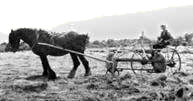
All the timbers used in the building on this farm except those used in the four-story laying-house, built in 1935, and in the remodeling of the homestead, in 1936, came from trees grown there; all the foundation stones were gathered in the fields except those cut from the limestone outcrop at nearby Stone Arabia. These were hauled to the Fonda Farm on home-made wagons drawn by teams of oxen and were loaded and unloaded manually. The huge stones forming the front porch and the smaller ones in the wall along the highway were secured in the same area. All the first fences were of stone gathered in the fields and carefully piled, one upon another to a height of about three feet. Trees were cut and stumps were destroyed by hand; seed was planted; crops were harvested by hand and stored without the aid of machines. It was during the earliest years of Douw Henry's grandchildren that machines began to replace the endless back breaking hours of labor on farms in the Mohawk Valley.