
(1844-1928) Sources: Century Farms of New York State
Albert Fonda was born and raised on the Fonda Farm, in Mohawk Township, just outside of the Village of Fonda. After his twelfth birthday, he attended the district school near his home only during the winter and early spring of the three following years. He was needed as his father's helper on the Fonda Farm. Nevertheless his active brain spurred him to avail himself of the information contained in the newspapers and periodicals of his era. He never lost interest in current events whether at local, state, national or international level.
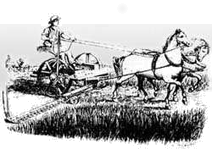
Deeply interested in government, he did not choose to hold office but preferred to sponsor and participate in most projects designed to benefit the farmers of his community and county. Gifted mechanically, he was the first person in his area to own and operate a steam engine which moved under its own power and motivated such labor-saving devices as the threshing machine, rye-rubber, corn husker, or sawmill. It moved its own water-tank, often also, one of the machines. Frequently a strong team of horses, widely known as "Dick", a bay and "Charlie", almost white, hauled a machine from farm to farm, not only in the immediate vicinity of the Fonda Farm, but in adjacent and rather distant ones.
A staunch Republican, Albert was disqualified from military service during the Civil War because he had lost the sight of his left eye during an attack of diphtheria during the epidemic of 1860. Later in 1889, while using his equipment to husk a neighbor's corn, he lost his left hand and nearly died of septicemia. A second amputation removed the lower arm just below the elbow. Despite such handicaps, his was a useful life until early in his 83rd year. He and his wife made every effort to educate their children, assisting them through high school and college and as much as possible when each embarked upon his or her career. Both he and his wife died at Fonda Farm. They are buried, as were their parents, brothers and certain sisters in the Evergreen Cemetery, near Fonda, New York.
His son, Albert Dow Fonda (1893-1962), also became a farmer, but he first attended Cornell University Agriculture College, graduating in 1917. Then, with WWI in progress, he enlisted in the U.S. Marines right after college graduation. He was assigned to the Key West, Florida, flight training school; however the war ended prior to completion. Albert then worked in a New Jersey Creamery until a logging accident partially disabled his father, thereupon he returned home to help on the farm. He continued with a successful farming career, taking after his father who had a farm machinery dealership. He also believed strongly in education, sending his children to (better) neighboring Johnstown schools and supporting them all in college educations; later helped foster the Fonda-Fultonville Centralized School, crusading against local rivalries.
State of New York; Executive Chamber
CITATION - In 1642 Jellis Douwse Fonda emigrated from Holland and settled in America near Rensselaer. In the course of the centuries his descendants migrated westward into the Mohawk Valley giving their name to the Village of Fonda, which is now the County Seat of Montgomery, County, One of them, Douw Fonda was killed on his farm during an Indian raid in the Revolution and he now lives in history as "Douw, the Patriot".
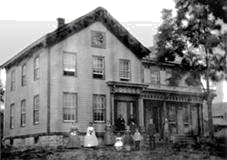
Not far from Old Johnson Hall, country seat of the great explorer and proconsul, Sir William Johnson, is a charming old farmhouse dignified and serene, mellowed by the passing of more than one hundred years. It is the home of Albert Douw Fonda, direct lineal descendant of Jellis Douwse Fonda, as well as of Douw, the Patriot. With his wife, Helen Clark Fonda, and his sister Miss Cornelia D. Fonda, Albert Douw Fonda operates a farm which is rightly one of the prides of the County, indeed of the Mohawk Valley.
On one hundred and thirty-five acres of crop land the Fondas own an enviable herd of registered Ayrshire cattle, with two thousand laying hens. It is in every sense a modern farm operated according to the best modern canons of scientific agricultural efficiency. Their son, Albert Granville Fonda, is an undergraduate of Cornell University. Two daughters have gone out into the world. The entire family - father, mother and children, as well as the sister, Cornelia Fonda - hold university degrees.
It is my pleasure and privilege as Governor of New York to welcome the Fonda family to the Honorable Order of Century Farmers. (signature) Thomas E. Dewey (embossed state seal) Fonda Farm, Town of Mohawk, New York, 1962 Century Farms (1847-1947) Booklet
The New World story of the Fondas begins in 1642 in the days of the Dutch occupancy of New Netherlands when Jellis Douwse Fonda came from Holland and settled near Rensselaer. He was succeeded by a son, Douw Jellis and a grandson born near Schenectady in 1700. This baby was baptized "Douw" according to the ritual of the Dutch Reformed Church to which his descendants still belong. When he was more than 50 years old Douw Fonda trekked westward up the Mohawk Valley into new country and here on land now encircled by the track of the Fonda Fairgrounds he built his home. With the outbreak of the Revolution thousands of colonists, loyal to the Crown, fled to Canada.
Among these Tories were the Johnson's, who had a manorial home at Johnstown, not far away. In the Mohawk Valley, there were some who allied themselves with the Johnson's, but the majority were true to the American cause. Among these were Douw Fonda and his three sons, John, Jellis and Adam, staunch patriots all, Jellis a Captain while Adam served as a Lieutenant Colonel under General Nicholas Herkimer at the bloody Battle of Oriskany near Utica in 1777. This battle prevented the British General St. Leger from giving expected relief to Burgoyne at Saratoga.
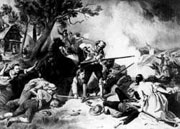
On May 27, 1780, occurred the raid which rendered Sir John Johnson infamous when he led a raiding party of Indians and Tories against his former neighbors. The 80-year old Douw Fonda was one of the victims, tomahawked by a Mohawk whom he had once befriended but who wanted the $8 bounty the British paid for a scalp. Adam Fonda was also seized and taken to Canada with 5 Fonda slaves and his house was burned. After the war Adam returned and built a house which is still standing in the village of Fonda. Jellis became a judge in Tryon County and was serving in the Legislature when he died. Adam's son Henry who served as a captain in the War of 1812 had twin sons called Henry Douw and Douw Henry. Douw Henry, the father of Albert Fonda whose son is the present owner, built the farm home between 1842-50. Now on this farm is the ninth generation of the family in America; the seventh on these historic acres. (Issued January 22, 1947)
Sources and references
- Century Farms of New York State: http://www.nysagsociety.org/cen_farms/index.htm