
(1615-1690) Sources: Early American Families, New York State Museum
Much of the story of the Fonda beginnings in the New World centers around Hester Janse, who today would be called feisty and tenacious. Hester was born in Leiden, Holland, Netherlands in 1615. Rev. W. A. Williams in his book, "Early American Families" states that she and her husband, Jellis, were probably cousins and related to the Dutch painter Gerrit Dou (1613-75) who was a student of Rembrandt and painted in the early Rembrandt style in his hometown of Leiden. Williams goes as far as to say that Hester and Gerrit were siblings. Dou, unlike most painters who were borderline paupers, became quite wealthy, having many of his works purchased by Europe's royalty. Captain Volkert Jansen Douw, who emigrated to New Netherlands in 1641 and was Albany's first magistrate, was also probably a relative.
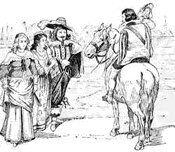
Jellis Douwse Fonda was born in 1614, the son of Douw Evertse Fonda (1580-1669) of Agum, Friesland, Netherlands. (Note: The father of Jellis is actually unknown, see Fonda DNA and History .) Jellis and Hester married on February 10, 1641 in Diemen, near Amsterdam, and had four children, Douw, Greetien, Sara and Abraham. Jellis worked as an innkeeper and blacksmith in Diemen.
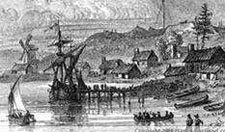
It is not certain exactly when or why the family emigrated to New Netherlands (America), other than the obvious desire for freedom and opportunity. There is no known record of the family on ship passenger lists of the time. The first record is after they arrived in Beverwyck (Albany) in 1651, at which time the children were aged eleven, nine and seven. It could be assumed that they were aboard one of the many ships out of Amsterdam during the initial settlement of the New Netherlands Colony led by Dutch explorer Henry Hudson's discovery in 1609 and the Dutch West India Company trading post operations, starting in 1624. Since the colony was intended strictly as a profit-making enterprise, and not as a means to transplant Dutch culture, the mouth of the Hudson River soon paled in comparison with the beaver-rich unexploited forests farther inland, where the company's traders could be in close contact with the Native American hunters who supplied them with pelts in exchange for cheap European-made trade goods and wampum.
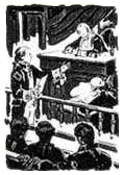
On October 19, 1651 Jellis was granted permission by the court to distill liquor in Greenbush, a small village across the Hudson River from Albany, in the region called Rensselaerwyck. The young family took the ferry across the river to Greenbush to establish their distillery next to the house belonging to Evert Pels, who himself operated one of the many breweries in Rensselaerwyck. Another record indicates that on June 16, 1653, Jellis brought suit against his neighbor, Jan Van Bremen, for failing to deliver a hog for which Jellis paid ½ anker of brandy, about 5 gallons. Jellis won judgment for 1.30 florins.
Jellis and Hester and their children remained in Greenbush at least through 1654. By 1658 they had crossed the river again to return to Beverwyck, the settlement outside Fort Orange. Around this time Jellis had fallen ill and had become incapacitated. He died the following year at the age of 45. While Jellis was still alive, Hester started up her own business as early as 1658, engaging in the lucrative beaver trade. Her commercial ventures continued for many years and she survived three husbands and an Indian Massacre and supported herself up to the time she died at age 75.
In 1658, while she was living in Beverwyck, she sued Hans Vos demanding payment of three beaver for a gun she sold him. The court ordered him to settle his account with Mrs. Fonda. In the same year she was sued by Ludovicus Corbus who charged that she had removed his wife's petticoat (from the fence). Hester answered that she had not taken the petticoat but that the plaintiff had pawned it for beaver. The case was continued for lack of evidence. Corbus again charged Hester with taking an apron without his consent. Hester explained that the plaintiff's wife had given her the apron as a pledge for 5½ beaver and she not being satisfied with the apron as a pledge, the plaintiff's wife also gave her an undershirt. If all this petty litigation sounds contemporary, Kiliaen van Rensselaer, the first Patroon, shrewdly noted in his records that, "they stir one another up, suing one another more as a diversion than for the redress of wrongs."
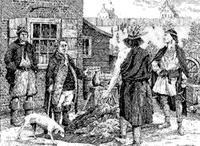
In 1660 Hester married Barent Gerritsen, a widower several years her junior. He arrived in Fort Orange as a youngster in 1646. Early in 1662, Barent, Hester and Sara, then about 16, moved to the newly settled community of Wiltwyck (Kingston). The settlers lived behind a stockade due to the threatening nature of the Esopus Indians. Barent, also a distiller, became famous for the superior type of brandy he produced and became modestly wealthy. Hester still continued her trading. It was truly a two career family, almost unheard of for another 300 years.
At noon on June 7, 1663, the Esopus Indians beat back the guard at the gate and burned most of the settlement to the ground. Barent was one of the first to be bludgeoned to death. Hester and Sara and most of the remaining settlers were taken prisoner and forced to trek through 22 miles of unbroken wilderness. It was not until three months later on September 7th that Hester was released from captivity, but not without the loss of Sara. Hester never recovered from the shock and exposure and remained deaf for the rest of her life.
That same year Hester returned to Beverwyck where her daughter Greetien and her son-in-law Jan Juriansen Becker, a teacher, and their children Jan and Martina, and her son Douw Fonda were living. She had become guilderless and beaverless due to the tragedy in Wiltwyck. She set about regaining her financial security. She sold her first husband's distillery equipment and she went back to court, the scene of many of her former triumphs. She was successful in collecting debts owed her deceased husband's estate. Then in 1670 she married again, Theunius van Vechten, a man several years her senior. Theunius died in 1685 leaving Hester his modest estate. Even at this time she was conducting business as usual. Her last recorded act before her death in 1690 (no, it was not standing before a judge) was standing before the altar of the Reformed Church of Jesus Christ of Albany at the christening of her grandchild Anna Fonda on February 2, 1690.
Sources and references
- Early American Families,: http://www.fonda.org/gallery/gallery.htm?gallery=3
- New York State Museum: http://www.nysm.nysed.gov/albany/whoarewe.html
- Fonda DNA and History: https://blog.fonda.org/archives/1362