
(1727-1791) Sources: History of Schoharie County, History of Oneida County Battle of Oriskany - 1777( see SAR Oriskany)
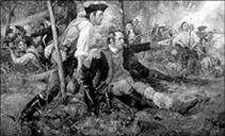
Jellis was born in Schenectady, first son of Douw Jellis Fonda; first merchant in the Mohawk Valley west of Schenectady, and was a very prosperous trader and landowner. He was a Major of militia and served under Sir William Johnson against the French and Indians in the Battle of Lake George. He then commanded a company in the Battle of Oriskany against the British. Later, probably because of his being physically incapacitated by an injured leg, he became associated with the home guards.
Jellis was also appointed a county judge and a state senator. As one of the "principal freeholders and inhabitants of the Mohawk River and settlements adjacent" he signed a petition to form Tryon County in 1771. In May 1780, his house, mill, and ashery were destroyed during Sir John Johnson's raid, causing $60,000 worth of property damage; he was away in Poughkeepsie, attending the Legislature. For many years he carried on an extensive business for the times, trading with the white citizens of the valley, and the natives of western New York; the latter trade being carried on at old Fort Schuyler, now Utica; Fort Stanwix
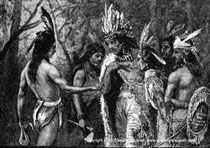
, now Rome, and Forts Oswego, Niagara and Schlosser. An abstract from his ledger shows an indebtedness of his customers at one time just before the revolution, amounting to over ten thousand dollars. Many of his goods he imported directly from London. To his Indian customers he sold blankets, trinkets, ammunition and rum; and received in return, peltries and ginseng root. The latter was at that time an important export item of what was then, Western New York; and the two named along with potash, almost the only commodities sold in a foreign market.
This early trade was carried on from the large stone store which stood near his residence. Jellis built a home and an "ashery" six miles west of Caughnawaga on the north side of the river along Canagara Creek. It was part of a great tract of 6,000 acres of land given by the Mohawks; about 1/16 to Captain Harmanus Van Slyke, whose grandmother was half French, half Mohawk. The deed of gift was confirmed to Captain Harmanus by King Charles I in 1723. The land runs along the Mohawk for six miles.
The eastern half Van Slyke sold to Colonel DePeyster, treasurer of the Province of New York, who owned it at his death. The trustees of his estate sold it to Jellis Fonda in 1768. It included what is known as "The Nose," a conspicuous landmark near this spot. Major Fonda, soon after acquiring the property, began the erection of his mills and "ashery," wood ashes being the source of potash. This complete set of buildings was destroyed in the first raid of Sir John Johnson, along with nearly every other building on the north side of the river from "The Nose," just east of Canajoharie down to Tribes Hill. Fortunately Major Jellis was not at home at the time. His wife and their son Douw were warned of the coming of the raiders and escaped across the river. The house was completely demolished and, it is said, while burning, a music box began to play. The Indians ascribed its music to "spirits."
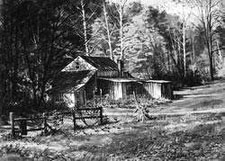
Fonda's Patent - This was the first patent in Oneida county granted in New York after the Revolution. It was granted Jan. 31, 1786 to Jelles (or Giles) Fonda. The 40,000-acre patent was issued on condition that within three years a settler for each 500 acres should be located on the land. The land of this patent is mostly in Rome and Floyd, with some in the town of Western, and there was quite a rush to settlers to those towns as the three year period came to a close.
The Oneida county records show that in 1786 Mr. Fonda sold portions of his patent as follows: an undivided one eighth to John Lansing, Jr., who was afterwards chief justice and chancellor of New York; an undivided one eighth in 1788 was sold to each of the following: Gov. George Clinton, William Floyd (one of the signers of the Declaration of Independence), Stephen Lush, and John Taylor. In 1787 the patent was surveyed into 100 lots by James Cockburn. The owners gave perpetual leases, reserving an annual wheat rent, so much per acre, payable in Albany. That was then the easiest way for the settlers in a new country to pay the rent and for their lands. Each year loaded teams with wheat for rent wended their way down the valley, stopping over night at the country tavern, the teamsters generally taking with them their own provisions and oats for their horses. The usual wheat rent was "18 bushels good merchantable winter wheat for each 100 acres". Fort Bull is in lot 98, very near the line of the Oriskany Patent. That lot fell to the share of George Clinton and later to Mr. L'Hommedieu.
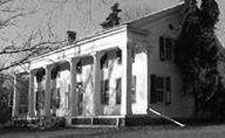
Following the war, in 1790, the Major built the present house on Montgomery Terrace in Fonda, overlooking the Valley from its sightly location, but unfortunately he never lived to occupy it. His slaves brought his body down the river from the home in which he was then living, doubtless a more or less temporary one on the site of the house destroyed by Sir John in 1780, and he was buried from the all but completed building. Following the funeral, his family occupied the new home.
There was much speculation in new lands in the interior of New York, between the French and American wars with England, and thousands upon thousands of acres changed owners for a mere song - land now valued at millions of dollars. Among the speculators were Sir William Johnson, Governor Tryon, Major Jellis Fonda, and Colonel John Butler. Lands on the Sacandaga River were brought into market at this period. Mr. Fonda had for many years been extensively engaged in merchandising, and was much of that period in the militia commissary department. He was a man of wealth, influence and respectability, and at the beginning of colonial difficulties, had the most flattering inducements offered him to side with the loyalists, which he promptly rejected.
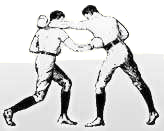
The following anecdote is believed to be true. In the employ of Sir William Johnson a few years before his death, was an Irishman named McCarthy, by reputation the most noted pugilist in Western New York. The baronet offered to pit his fellow countryman against any man who could be produced for a fist fight.
Major Fonda, tired of hearing the challenge, and learning that a very muscular Dutchman named John Van Loan, was living near Brakabeen, in the Schoharie Valley, made a journey of some forty or fifty miles, to secure his professional services, for he, too, was reputed a bully. Van Loan readily agreed to flog the son of Erin, for a ten pound note. At a time appointed, numbers were assembled at Caughnawaga to witness the contest between the pugilists. After McCarthy had been swaggering about in the crowed for a while, and greatly excited public expectation by his boasting, inducing numbers to bet on his head, his competitor appeared ready for the contest - clad for the occasion in a shirt and breeches of dressed deer skin fitted tight to his person. A ring was formed and the battle commenced. The bully did his best, but it was soon evident that he was not a match for his Dutch adversary, who slipped through his fingers like an eel, and parried his blows with the greatest ease. Completely exhausted and almost bruised to a jelly, Sir William's gamester was removed, looking if not expressing bewilderment. (Abraham A. Van Horne, who obtained the facts from a son of Van Loan).
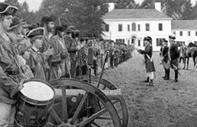
In a letter to Maj. Taylor, then commanding the Johnstown Fort, dated November 27 (1779), Col. Fisher states that he is under the necessity of convening a court martial on the following day, and that he, the Major, should attend, bringing with him another officer, also to act as a member. The same letter states that an accident happened at that fort the same morning, by which two men were wounded-one mortally. The nature of the accident is perhaps explained in a letter from Col. Fisher to Gen. Ten Broeck, dated the 28th instant.
In it he states, that during his absence to visit Fort Plank, a detachment of men from Col. Stephen J. Schuyler's regiment mutinied, and expressing a determination to leave the fort, charged their pieces with ball, in presence of the officers. They were at first persuaded to unsling their packs and remain until Col. Fisher returned, but seeing Captain Jellis Fonda, (known afterwards as Major Fonda,) then in temporary command of the garrison, writing to Col. F., the mutineers again mounted packs, and knocking down the sentinels in their way, began to desert in earnest. Capt. Fonda ordered them to stand, but not heeding his command they continued their flight, when he ordered the troops of the Fort to fire upon them; the order was obeyed, and Jacob Valentine, one of the number, fell mortally wounded, and expired the next morning. The letter does not so state, but I have been advised that the deserters considered their term of enlistment at an end. The court martial, I suppose, convened to try Capt. Fonda, as I have been credibly informed that he was thus tried, and honorably acquitted.
Sources and references
- History of Schoharie County,: http://www.rootsweb.com/~nyschoha/simms4.html
- History of Oneida County: http://www.rootsweb.com/~nyoneida/misc/wager/ch10.html
- see SAR Oriskany: http://www.oriskanysar.org/battle.htm
- Fort Stanwix: http://www.nps.gov/fost/