
Sources: State Historical Society of Wisconsin ; Chicago: Its History and Its Builders
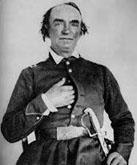
Born in Watervliet, Albany Co., New York; trekked to Prairie Du Chien, Crawford Co., Wisconsin in 1825. He was an Explorer, Trader, Mail Carrier, Indian Agent and Civil War Officer (Colonel). Although he moved away from the family homestead at an early age, John had six brothers (some half-brothers) that also served in the Civil War, and both of his grandfathers served in the Revolutionary War. There is a life-size painting of Col. John H. Fonda hung in Wisconsin Capital Building. In 1827, during Red Bird's Winnebago rising, John H. Fonda ran the mail from Fort Dearborn (today's Chicago) to Fort Howard at Green Bay. In 1829, under the direction of Col. Z. Taylor, he served as pilot for an expedition to the pineries of the Menomonee River to cut logs for the construction of Fort Crawford in Prairie du Chien. He later served as Crawford County Coroner (1846), District Court Justice (1850), Indian Agent and Constable for the county at which time consisted of the entire western half of present-day Wisconsin.
John H. Fonda, trader and mail carrier of Prairie du Chien, passes through Chicago in 1825 and will later record his experience: [Lake Peoria] ... At length the councils were concluded, and our [Indian] guide signified his willingness to proceed. Under his direction we paddled along until we came to the Des Plaines river, from which we passed into a large slough or lake [Mud Lake] that must have led us into a branch of the Chicago river, for we followed a stream that brought us opposite Fort Dearborn. At this period, Chicago was merely an Indian Agency; it contained about 14 homes, and not more than 75 to 100 inhabitants at the most. An Agent of the American Fur Company, named Gurdon S. Hubbard, then occupied the Fort. The staple business seemed to be carried on by Indians and run-away soldiers, who hunted ducks and muskrats in the marshes. There was a great deal of low land, and mostly destitute of timber. The principal inhabitants were the agent, Mr. Hubbard, a Frenchman by the name of Ouilmette, and John B. Beaubien. It never occurred to me that a large city would be built up there. ... But to go on with my story, we departed from Fort Dearborn in a fishing boat and proceeded north along the Lake shore toward Green Bay.
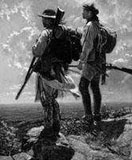
John H. Fonda returns again during the winter of 1827 and later shares: "... I was mail-carrier in the North-West before there was a white settlement between Prairie du Chien and Fort Snelling. ... It was the winter of 27, that the U.S. Quartermaster, having heard of me through some of the men with whom I was a favorite, came to me one day and asked me if I could find the way to Chicago. I told him it wasn't long since I made the trip by the Lake. He said he wanted a person who was not afraid to carry dispatches to the military post at Fort Dearborn. I said I had heard that the Indians were still unfriendly, but I was ready to make the attempt. ... [willing to] carry the mail between Fort Howard, at Green Bay, and Fort Dearborn, commanded by Capt. Morgan, that stood on a point now forming a part of the City of Chicago. ...
I chose a companion to go on the tramp with me. He was a Canadian, named Boiseley, a comrade with me for many years. It was in the company of this Boiseley that I presented myself before the Quarter-Master, and reported ourselves ready for the start. He intrusted me with the mail-bag, but a tin canister or box of a flat shape, covered with untanned deer-hide, that contained the dispatches and letters of the inhabitants. ... One noon we arrived at the southern terminus of our journey at Fort Dearborn after being on the way for more than a month. It was in January, ... and with the exception that the Fort was strengthened and garrisoned, there was no sign of improvement having gone on since my former visit [1825]. This time I was on business, and I advanced up to the sally-port with a sense of my importance, was challenged by the sentry, and an orderly conducted me to the Adjutant's office, where I reported myself as the bearer of dispatches for the commanding officer. Captain Morgan was in the office, and, advancing, intimated that he was that person and took the case of letters, directing me to await his further orders. Getting a pass, I went outside the palisades to a house built on the half-breed system partly of logs and partly of boards. This house was kept by a Mr. Miller, who lived in it with his family. Here Boisely and I put up during the time we were in the settlement. I received my orders from Morgan about the 23d of January, and prepared to return with other letters. We started up one branch of the Chicago river, and after leaving this we followed the Des Plaines, taking pretty much the same way we had come."
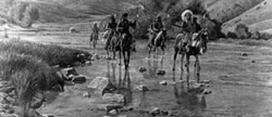
Concerning the removal of the Winnebago's, John H. Fonda says: "During the year 1848, just previous to the adoption of the State Constitution, the Winnebago Indians were scattered through the country along the Wisconsin and Fox rivers, through the Kickapoo timbers, and the Lemonweir Valley. Orders came from the sub-Indian agent, J E Fletcher, to collect and remove them to their Reservation, near Fort Atkinson, Iowa."
"In 1848, when orders were received at Fort Crawford to remove the Winnebago's, several attempts were made to do so, but with poor success. Early in the same year I received the following official letter:" Office Sub-Indian Agent, Turkey River, Jan. 4, 1848 Sir: In answer to your inquiry respecting the disposition to be made of the Winnebago Indians, who may be found wandering about through the country, I have to say that I wish you to arrest them, cause them to be securely guarded, and report them to me as early as may be practicable. Very respectfully your obedient servant, J E Fletcher, Indian Agent." "To Lieut. ---, Commanding Ft. Crawford, Wisconsin Territory
Upon receipt of the above, I made all necessary preparation, and started with fifty men to collect the Indians. This attempt was quite successful, and several hundred were arrested, and sent to Fort Atkinson, Iowa. It may appear strange to some persons that such a handful of men could take many hundred Indians prisoners, and guard them day and night as we traveled through a wild unsettled country; but it was done, and I have a list of names of those men who accompanied me on that expedition. My journal, kept during the time we were hunting the Indians, presents numerous interesting items, only one or two of which, I will relate..."
Sources and references
- State Historical Society of Wisconsin: http://www.wisconsinhistory.org/wlhba/searchResults.asp?adv=yes&ln=Fonda&fn=John&q=