
(1838-1923) Sources: Pearce Civil War Collection, Civil War Times Illustrated Ten Eyck was born in Fonda, New York, and served as a United States Army telegrapher during the Civil War. He moved his family to Illinois and then Nebraska in 1878 for railroad work and he died in Omaha, Douglas, Nebraska.
Telegraphers served under the quartermaster and were mostly civilians. Although they were integral parts of the army and vitally important to the country, they were unfortunately not given the same status as soldiers. The job was perilous, and in the course of the war over three hundred telegraphers lost their lives in the line of duty. Ten Eyck Hilton Fonda, called "Nike" by family and friends, was one of the young men responsible for the Union's telegraphic lifeline. In the days just before the Battle of Gettysburg, Pennsylvania, as the Union and Confederate armies groped toward one another, Fonda was the telegrapher who received an urgent message from Washington; he recounted his experience to a local newspaper in Omaha, Nebraska, 50 years later (1913). The newspaper printed the text of the telegram:
To Major General Meade, Commanding Army of the Potomac: On March: The advance guard of the confederate army under General Early have entirely evacuated Wrightsville and other points on the Susquehanna river, and are making a forced march to join General Lee's main army at a point between Hanover and Gettysburg - part of their forces now at Hanover - and they confidently expect to be able to form a junction with General Lee's main army not later than tomorrow evening. Circumstances and conditions permitting, I would urge you to assume the offensive is quickly as possible on Lee's divided forces. - E. M. Stanton, Secretary of War.
At midnight June 30, 1863, Fonda personally delivered the telegram transcription from Secretary of War Edwin Stanton to General George Meade of the Union Army warning him of the advancing Confederate Army under Robert E. Lee toward Gettysburg and commanding Meade to assume the offensive. Fonda is credited with delivering this important warning, which allowed the Union armies to prepare for the approaching Confederates. An Omaha, Nebraska newspaper, during the fifty-year reunion of the battle of Gettysburg, named Fonda "the agent that began the conflict."
Fonda described his "every effort" in this letter to his brother (Douw Henry Fonda), written on telegraph message blanks: My Dear Brother, I suppose you have had plenty of war news of late as I have sent many pages by telegraph within the last two days. The report of today's Herald from Carpenter (I suppose it's published I sent it to Washington to censor) was I think sublime. He wrote it here in office flanked on the right by a bottle of bourbon whiskey (to keep his ideas bright) and on the other side by seven or eight noisy operators. From some cause our line has not been built from here to the front. This being the nearest telegraph office to the army our business is immense. When the army moved forward from this place there were no troops left here not even an orderly to carry dispatches to the front.
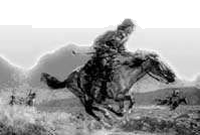
On the 30th Washington War dept. received an important dispatch from Gen. Couch at Harrisburg [Pennsylvania] informing Secy. Stanton that the enemy were falling back from Harrisburg and were concentrating at Gettysburg and to inform Gen. Meade in any way possible. I was the individual selected to carry it to Gen. Meade. Having rode from Leesburg the day before I felt rather unlimbered but consented to go without any excuses - I left here at one o'clock a.m. - full moon making the night almost day. I had little or no thought of reaching Meade's Headquarters as the country was full of the Rebel scouting parties and we did not know exactly where Headquarters were but supposed somewhere in the neighborhood of Middleburg 25 miles from here.
I had orders to spare nothing, horseflesh and money was of no account if I would only deliver the message. I tell you I made the old horse get. To Woodburg 12 miles I made in less than an hour as I heard a clock strike 2 as I was watering my horse.
Thus far I had not met a single person. I saw one straggler asleep along the road, four miles from this place I heard some one coming towards me at last. I saw him coming on a walk one of our men I suppose he was dressed in our uniform - saber carbine & revolver. I was going 240 and halted within twenty feet of him and halted him, he said friend - I saw his heart was way up in his mouth and too scared to do much damage. I rode up to him and asked him the way to Headquarters, which he said was Middleburg. The horse was exhausting heavy now. His feet & mouth made noise enough for a whole cavalry regiment. I soon came into Middleburg but my spirits were soon dampened by finding the last of the army had passed through there that day at four o'clock some towards Tullytown, others to the left & right. I thought Headquarters would keep the centre and made for Tullytown, seven miles away. Three miles this side of that place I came to a train of wagons parked - many pickets had they out on this road. I learned Gen. Meade's Headquarters were one mile beyond Tarrytown - which place I reached delivering the message to him in person taking a receipt timed at 5.15. He gave me a fresh horse and an escort of fifty cavalry and I came back same day.
Secy. Stanton sent me a message thanking me kindly for energy &c. but I suppose he has forgot it by this time. When you read this destroy it for if you send it home every man Father comes across he will show it to. It is quite natural - but I don't want to become notorious. I shall probably be home in a month or two to remain for a short time, Love to all. Ever Your Bro., Nike. Frederick Md., July 4th 1863.
Sources and references
- Pearce Civil War Collection: http://www.pearcecollections.us/civilwar/fa_ind.php?fid=260
- Civil War Times Illustrated: http://www.historynet.com/cwti